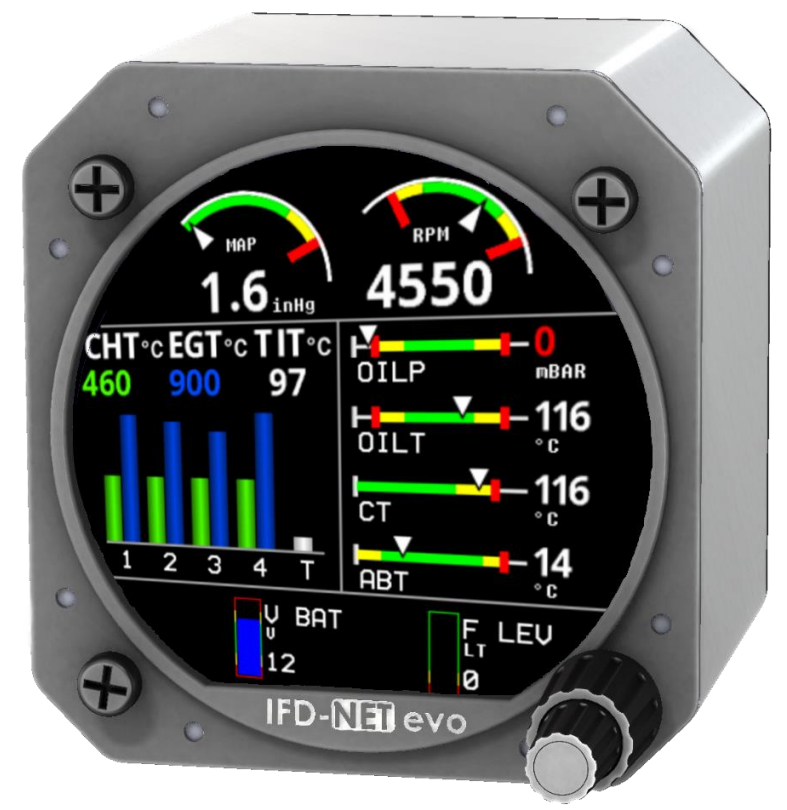
The iFD-EVO EMS (Engine Monitoring System) is the top-tier digital engine management unit from M.A.V. Avionic Division. Designed specifically for microlight, LSA, and experimental aircraft, intended to replace an entire panel of traditional analogue gauges with a single, high-definition 80mm instrument.
Core Capabilities The "Full" designation primarily refers to the increased number of sensor inputs available compared to the Base version.
Expanded Sensor Support: The EMS supports up to 12 sensor/thermocouple inputs (6 on the Base). This makes it the standard choice for up to 6-cylinder engines or 4-cylinder engines where you want to monitor every individual cylinder for both CHT and EGT simultaneously.
Comprehensive Monitoring: It covers all critical parameters:
RPM: Precise digital tachometer.
CHT / EGT: Individual monitoring for multiple cylinders.
Oil & Fuel: Pressure and temperature.
Fuel Management: Real-time fuel flow and fuel level with calculation of endurance and range.
Manifold Pressure (MAP): Essential for constant-speed propeller setups or turbocharged engines.
Hardware & Display The EVO range features significant hardware upgrades over the older "NET" series:
True-Round Display: It uses a high-definition, 78mm active area that fits into a standard 80mm hole. The metallic bezel is ultra-thin (less than 2mm), maximizing the screen size.
Sunlight Readability: The display is exceptionally bright, rated at 1200 cd/m² (nits), ensuring it remains visible even in an open-cockpit aircraft under direct UK sunlight.
Power-PC Architecture: A faster processor ensures smooth graphics and rapid data processing, which is critical for real-time engine health alerts.
Control: Operated via a dual concentric rotary knob with a push-switch, designed for easy use even when wearing flight gloves.
Key Advantages for Pilots
Space Saving: Consolidates up to a dozen individual gauges into one spot.
Smart Alerts: Unlike analogue needles, the EVO will flash and alert you the moment a parameter crosses a safety threshold, allowing you to focus more on flying and less on scanning gauges.
Reliability: Built with solid-state components, it is less susceptible to the vibration-related failures common in mechanical instruments.